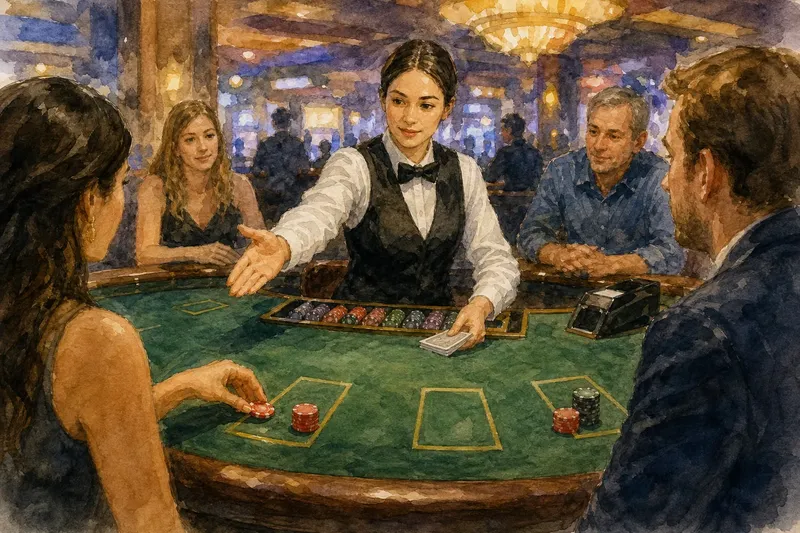
How to Read a Casino Scene in a Film Without Buying the Fantasy
Read a casino scene in a film by tracing its sound, edits, and character cues, so spectacle stays separate from what real play can tell you.
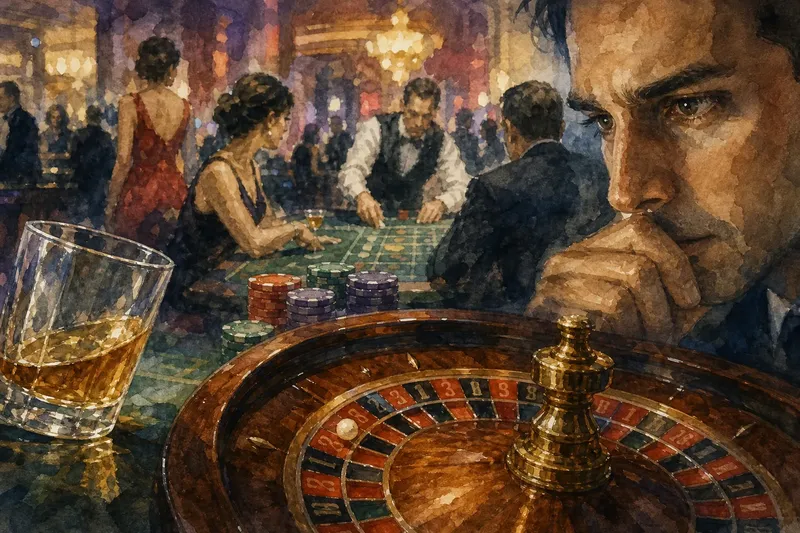
A glass tilts beside a roulette table; the wheel’s bright rattle swells, then the film cuts to a face just before the ball settles. To read a casino scene in a film, track how sound, editing, and character behavior guide your attention. The scene may show a game, but its main job is often to shape suspense, status, or danger—not to model real play.
Start with the frame
Notice what the camera makes easy to see and what it leaves out. A close shot of a hand placing chips can make a decision feel intimate, while a wide view of a crowded floor can turn the room into a spectacle. Neither view gives you a full account of what is happening at the table.
Look for the scene’s visual anchor. It might be a dealer’s hands, a player’s expression, a stack of chips, or a doorway in the background. The anchor tells you what the filmmaker wants to matter. If the camera keeps returning to a character’s eyes, the game may be serving as a stage for the character’s fear or resolve.
Then check the edges of the frame. Are other players visible? Does the film show the table layout, or only the hero’s side of it? Are staff members present as people, or just as moving shapes? These omissions can be meaningful. A scene trimmed down to a single player and a single wager can feel like a private duel, even though a real casino is a shared, regulated space with many competing demands on attention.
A useful analogy is a theater spotlight: it brightens one performer while leaving the rest of the stage in shadow. The spotlight can clarify the story, but it is not a map of the whole room.
Listen for the edit
Film sound often tells you how to feel before the image explains why. A busy room may be reduced to a low murmur when a character makes a consequential choice. A chip click may be amplified, or music may rise over the table. Those choices create emphasis; they do not tell you that the highlighted sound has special meaning in the game.
Listen for changes rather than treating every sound as literal. A sudden hush may be an editorial cue for tension, not an accurate record of the room. A swelling score can make a routine action seem momentous. If ambient noise vanishes between shots, the cut may be helping the audience follow a character’s inner state rather than documenting the space continuously.
Pay attention to the rhythm of the cuts. Rapid alternation between a player, a dealer, and the table can make an ordinary sequence feel like a contest of wills. A held shot can do the opposite: it can make a pause seem loaded, even if the film has skipped the ordinary actions that surround it.
Try asking, “What did the edit make me wait for?” If the answer is a result, a reaction, or a reveal, the scene is organizing suspense around that moment. The edit is a storyteller’s clock. It need not match the pace or sequence of a real game.
Read character behavior
Watch what characters do when the camera is not centered on the game. A player may study another person, glance at an exit, touch a drink, or hold still while everyone else moves. These gestures can suggest confidence, deception, anxiety, or fatigue. They are clues to the screenplay’s characterization, not dependable ways to identify skill or predict an outcome.
Compare behavior with the dialogue. A character who claims to be calm may be framed with restless hands; someone who speaks little may receive the most deliberate close-ups. The mismatch creates subtext. It can also steer you toward a judgment before the film has shown enough to support it.
Notice who gets to explain the rules. If one character translates every action for another, the scene may be placing the audience in the newcomer’s position. If no one explains anything, the film may be using uncertainty to make the room feel intimidating. Either choice serves the story. Neither is a substitute for learning how a game works from reliable, game-specific information.
Say you watch an invented scene in which a newcomer sits at a blackjack table, hears a low musical pulse, and looks from the dealer to an experienced player. The camera cuts to the newcomer’s hand hovering over the felt, then to the experienced player’s fixed expression. The expected observable effect is clear: you may feel that the choice is a test of nerve. That impression comes from staging and editing; the scene alone does not establish what action is sensible or what result will follow.
Separate story from play
A film often compresses events so that a casino scene can carry a plot point in a few minutes. It may skip routine pauses, simplify a game’s options, or make one result appear to settle a character’s future. That compression is normal storytelling. It becomes misleading if a viewer treats the dramatized sequence as a guide to real decisions.
Keep three questions distinct:
- What happens on screen? Identify the visible action without adding an explanation the film has not supplied.
- What does the film want me to feel? Look at music, framing, pacing, and reactions.
- What could I responsibly infer about real play? Usually, very little from a dramatic scene alone.
This separation is useful when a film depicts a character winning after a bold move. The outcome may be arranged to reward courage, create irony, or set up a reversal. It does not make the move a sound strategy. Fiction can select an extraordinary result because it serves the story; everyday decisions do not come with a screenwriter arranging the next beat.
Also distinguish visible confidence from knowledge. A character may handle chips with ease or speak as if the outcome is obvious. Those details can establish a persona, but confidence is not evidence that the character understands the game or can control chance. The film may even be setting up a fall by making that confidence look persuasive at first.
Notice the public image
Casino scenes carry familiar cultural signals: polished surfaces, hushed exchanges, bright tables, guarded doors, and people who seem to know more than they say. A filmmaker can use these elements to suggest glamour, risk, corruption, escape, or social access. Ask which meaning the scene attaches to the room, and whose point of view makes that meaning feel natural.
Look at who belongs in the frame. Does the scene focus on a celebrity-like gambler while staff and other visitors recede? Does it present the casino as an exclusive club, a workplace, a tourist stop, or a place of pressure? The answer affects how the viewer reads the setting. A character entering a casino may be framed as crossing into a world of possibility, but that is a narrative threshold, not a promise about what the place offers.
Costume and movement matter too. A neat suit, a slow walk, and a measured glance can signal authority through familiar cinematic shorthand. A hurried entrance or a character looking lost can mark them as an outsider. These cues tell you how the film sorts its characters. They do not establish who has an advantage at a table.
When a scene feels glamorous, ask what it has excluded. The film may not show time passing, money leaving a player’s hands, ordinary interruptions, or the practical limits of a night out. That absence is not automatically an error: a story has limited space. But noticing it keeps the polished image from becoming a complete picture in your mind.
What questions do viewers ask?
Can a movie teach me a casino game?
A scene may introduce a table, a few terms, or the broad shape of an action, but editing can leave out rules and context. Treat it as a starting point for curiosity, not as instruction for real play.
Why do casino scenes sound so quiet?
A mix may lower room noise to spotlight a decision, a line of dialogue, or a character’s reaction. That quiet is often a dramatic choice rather than a literal account of the room.
Are characters’ tells reliable clues?
Not by themselves: an actor’s glance or hand movement is arranged to communicate a role to the audience. A film can make a gesture look meaningful without establishing that it predicts anything in real play.
How can I tell when a scene is building suspense?
Watch for delayed results, repeated reaction shots, tightened framing, and music that gathers around a choice. Those devices signal that the scene wants you to anticipate a reveal, not that the game itself has changed.
Keep a viewer’s distance
On a rewatch, choose one element at a time: sound, camera position, cuts, or character behavior. Notice what it asks you to expect, then compare that expectation with what the scene actually shows. This small habit helps separate the film’s emotional argument from the game’s visible mechanics.
For a casino scene in a film, the most useful question is not “What should I do at that table?” but “How did the scene make this moment feel inevitable?” Trace the music, framing, and reactions that built the feeling. Once you can see the craft, the scene can remain exciting without passing itself off as advice.