Why a Dealer Announces the Action Before It Moves
Why a dealer announces table-game actions: learn how calls and gestures clarify betting, turns, and the boundary between one phase and the next.
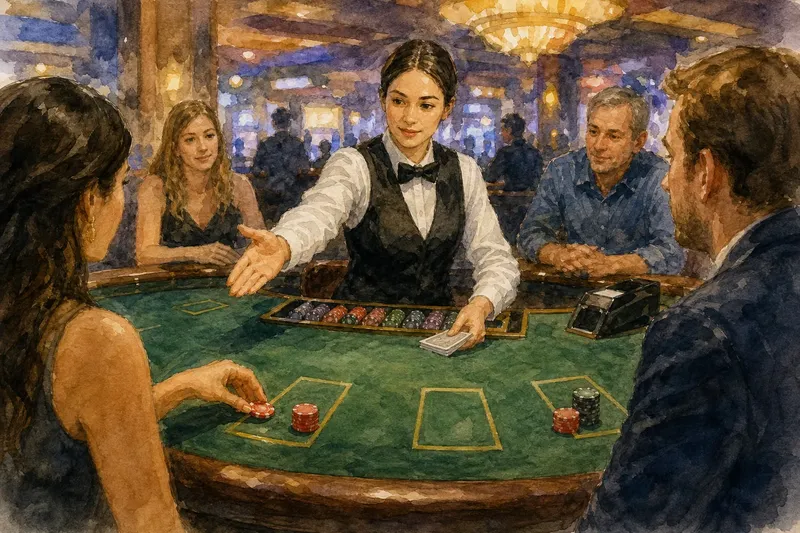
A player rests a chip beside the betting area while the dealer gathers the cards from the previous hand. Then the dealer says, “Place your bets,” and gestures toward the table. In casino games, that call makes the next phase visible: players know wagering is open, and observers can follow the shift from one hand to another.
Table calls mark phases
Casino table games move through distinct phases. Depending on the game and house procedures, players may place wagers, take turns, watch cards or other game materials move, and then see the result settled. Calls such as “Place your bets,” “No more bets,” and “Your turn” help mark those transitions.
The dealer’s words address the whole table, not just one player. Someone deciding what to do may be looking at their cards or chips, while an observer may be watching from behind the table. A clear announcement gives everyone a shared cue, so no one has to infer the sequence from a quick movement alone.
A spoken call works like a label on a drawer: it identifies what is happening without changing what is inside. The dealer’s gesture supplies a second cue. Voice and movement together make a phase easier to recognize in a busy casino, where conversation and background noise can compete for attention.
An imagined blackjack hand
Say a hypothetical player named Mina joins a blackjack table as the dealer finishes settling the previous hand. She puts a chip near the betting area but is unsure whether the next wagering period has begun. This invented situation shows how words and gestures can clarify procedure.
The dealer finishes gathering the cards, says, “Place your bets,” and gestures toward the betting area. Mina hears the call and sees the gesture, so she understands that the table is accepting wagers for the next hand. She places her chip in the marked area and moves her hand away.
When the other players have finished, the dealer says, “No more bets,” and makes a closing gesture. Mina can see that the wagering phase has ended. The dealer then begins dealing. Later, when it is Mina’s turn to act, the dealer indicates her position and says, “Your turn.” She can distinguish a cue meant for her from a nearby movement that belongs to another part of the hand.
After the hand, the dealer calls the result and settles wagers according to the table’s rules. Mina can follow the sequence from open betting to settlement. The announcements do not predict her cards, improve a wager, or make a particular choice more likely to win; they explain where the game stands.
Why voice and gesture work
Speech and gesture address different visibility gaps. A player whose view is blocked may hear the announcement; someone who misses the words may see the dealer’s hand. When the cues match, the meaning depends less on any one person’s attention or position.
Timing also matters. A call made before an action gives players a chance to understand what is about to happen. If an announcement comes during or after a movement, a player may wonder whether the phase has already changed. Dealers use calls to establish the next part of the game before the table moves into it.
Calls are procedural cues, not a promise that everyone will hear or interpret them identically. House rules and procedures vary by game and casino. If a call is unclear, pause and ask the dealer what phase is underway before acting.
What do common calls mean?
What does “No more bets” signal?
It signals that the wagering phase has closed for that round. It does not reveal anything about the cards or the likely result.
Why does the dealer gesture too?
A gesture gives the spoken call a visible counterpart, which can help someone who cannot hear clearly or has a limited view. It also distinguishes an announced action from an incidental movement of chips or cards.
Can a call tell a player what to choose?
A call can identify whose turn it is or which phase is underway, but it is not advice about what to do. Treat it as information about procedure, not the chance of a particular outcome.
What if someone misses the announcement?
Pause and ask the dealer to clarify the current phase before acting. Asking is more reliable than guessing from another player’s movements.
Reading dealer announcements
When watching a casino table, track the sequence rather than treating familiar phrases as omens. Notice what the dealer says, whether a gesture accompanies it, and what action follows. Those observations help distinguish an invitation to wager from the closure of betting or the start of a player’s turn.
- If you hear “Place your bets” and see the dealer indicate the betting area, then identify betting as open; if the call or gesture is unclear, ask before placing a wager.
- If you hear “No more bets” and see a closing gesture, then treat wagering as closed; if the cues seem to conflict, pause and ask the dealer to clarify.
- If the dealer says “Your turn” while indicating your position, then understand that the game is waiting for your action; if you are unsure what choices the game permits, ask the dealer to explain the procedure.
- If you see cards being gathered without a clear call, then do not assume a new betting phase has started; if you intend to wager, wait for the table’s opening cue or ask.
- If background noise makes a call hard to hear but the gesture is visible, then use it as a reason to pay attention, not as a substitute for certainty; if the phase remains unclear, ask for repetition.
- If a call and gesture appear to point to different actions, then avoid acting on an uncertain cue; ask the dealer which phase is active before moving chips or making a decision.
Ritual without prediction
Repeated calls can give a casino game a familiar rhythm: an invitation to wager, a closing cue, the hand itself, and settlement. That pattern helps players and observers follow the action, but repetition is not a hidden technique or a sign that fortune is changing.
For Mina, the useful result was a clear answer to a practical question: betting had opened when the dealer announced it and gestured toward the betting area. If she missed a later cue, she could ask rather than guess. A dealer’s announcement makes the boundary between phases easier to see; the game’s outcome remains separate from the call.
When you watch a table, listen for the announcement and notice the gesture that follows or accompanies it. Use those cues to understand what is happening now, and ask the dealer when the procedure is not clear.