How Fortune Became a Character in Stories
How Fortune became a character in stories, from ancient Tyche and Fortuna to the medieval wheel and later literary scenes about chance and choice.
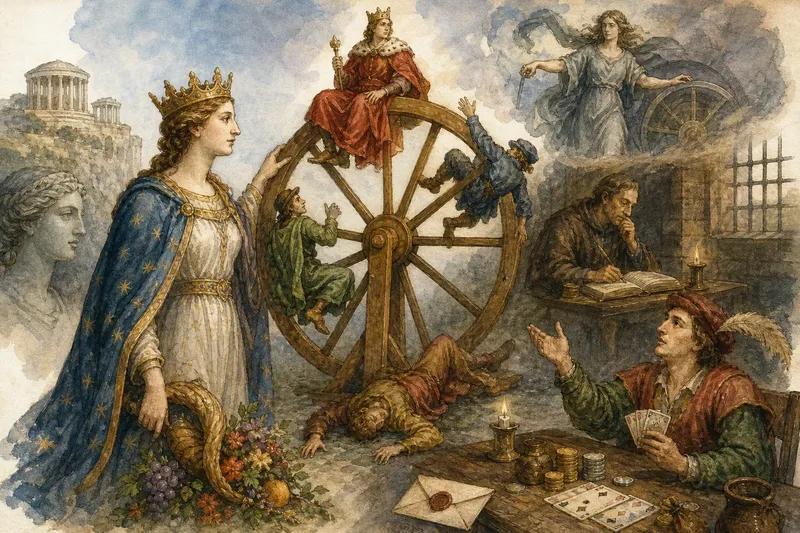
A crowned woman stands beside a turning wheel in a medieval image, while figures rise and fall around its rim. That scene helps explain how Fortune became a character in stories: writers gave uncertain events a recognizable face, then changed what that face could mean from one era and genre to another.
Ancient names and roles
In ancient Greek writing and tradition, Tyche was associated with fortune and the fortunes of cities as well as individuals. Roman writers used the name Fortuna for a related personification. Artistic depictions could pair these figures with objects such as a wheel, a rudder, or a cornucopia, suggesting change, direction, or abundance.
Those images do not tell us that every ancient community understood fortune in the same way. A text might invoke a city’s protective Tyche, use Fortuna as a poetic figure, or draw on both civic and literary associations. When reading a passage, keep its setting and purpose in view rather than treating every mention as evidence of a single shared belief.
Boethius and the wheel
In late antiquity, the Roman philosopher Boethius wrote The Consolation of Philosophy. Its dialogue between the imprisoned narrator and Lady Philosophy includes an argument about Fortune and changing circumstances. The work became an important route through which the wheel of Fortune appeared in medieval thought, though the image had a broader history than any one text.
Medieval writers and artists often arranged people around a wheel: one climbs, another sits at the top, and another falls. The visual pattern turns changing rank into an easy-to-read image. Like a revolving door, the wheel suggests movement rather than permanent possession; it is a literary and artistic metaphor, not a description of a force that controls every event.
Fortune on stage
In medieval allegory and later literature, Fortune could speak, judge, tempt, or serve as a comic adversary. Giving an abstract idea a voice lets a writer stage an argument: a character can appeal to Fortune, accuse her of unfairness, or claim to have mastered her.
The effect depends on genre. A solemn allegory may use Fortune to frame questions about human limits, while a comedy may let a character blame her for a foolish decision. Look at what the scene makes Fortune do, and at how other characters respond, before deciding whether she functions as a divine presence, an allegorical figure, or a convenient excuse.
Lady Luck and gambling
In later storytelling, “Lady Luck” can work as a familiar way to speak about uncertainty without presenting Fortune as a literal goddess. A character might use the phrase to express hope, fear, bravado, or disappointment. The words alone do not establish that luck has supernatural power in the story.
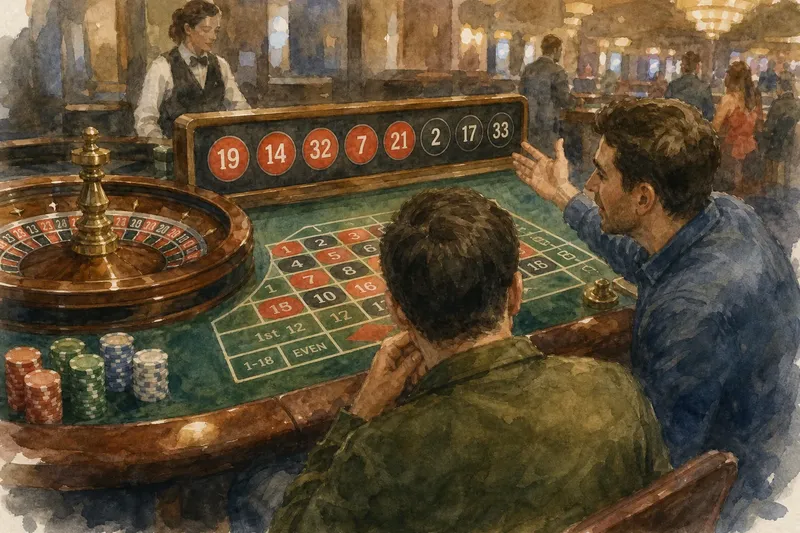
Gambling scenes make that distinction especially useful. A character’s appeal to Fortune tells readers how that person interprets an outcome; the rules come from the story’s description of the game. If the fictional world explicitly gives Fortune power over play, that is a feature of the story, not a rule for real games.
Questions about Fortune?
When did Fortune first appear in stories?
There is no single starting point that can be named for personified fortune. Greek Tyche and Roman Fortuna belong to ancient traditions, and later writers adapted related figures for new literary settings.
Why is Fortune shown with a wheel?
The wheel offers a compact image of people rising or falling as circumstances change. Medieval writers and artists used it to challenge the idea that status or success must last.
Is Lady Luck a goddess or a metaphor?
That depends on the work and its setting. A writer may present Fortune as a divine power, an allegorical character, or a familiar expression for events a character cannot explain.
Does luck change the rules in a gambling story?
Only when the story explicitly establishes that as part of its fictional world. Otherwise, a character’s appeal to Lady Luck is characterization, not a statement of how a real game operates.
Reading Fortune in context
To interpret a reference, note the work’s setting, genre, and the actions Fortune is given. Then distinguish an older symbol from the meaning a particular writer assigns it. These checks help keep religious tradition, literary convention, and a character’s personal language from collapsing into one idea.
Imagine a play set in a merchant’s shop. At the start of a scene, the merchant has one sealed letter announcing a change in his prospects and a stack of playing cards on the counter. He reads the letter, calls on Fortune, then sits down to play. The next scene shows an allegorical figure turning a wheel, but the play gives her no power over the cards. A reader can treat the wheel as a symbol of changing circumstances, the merchant’s words as a reaction to uncertainty, and the game’s stated rules as separate from both.
- Setting: If the work names a city or invokes Tyche or Fortuna, consider whether civic or religious associations matter; if it gives no such context, do not assume the figure is being worshiped.
- Wheel: If Fortune appears with a wheel and the plot shows a reversal, connect the image to changing circumstances; if no reversal follows, treat it as an allusion rather than proof of a plot pattern.
- Agency: If Fortune speaks or acts, check whether the work gives her supernatural powers; if it does not, read her as allegory or personified speech.
- Genre: If the scene is comic and a character blames Fortune, look for vanity or evasion; if the scene is solemn, consider whether Fortune frames a moral or philosophical question.
- Gambling scene: If a player addresses Lady Luck, separate that belief from the rules the story states; if the plot explicitly gives Fortune power, treat it as a fictional rule.
- Historical claim: If someone calls a work the first or earliest use of Fortune, ask what evidence supports that claim; if none is offered, describe it more cautiously as one example in a longer tradition.
How Fortune became a character in stories is best understood as a sequence of adaptations, not a single handoff: ancient Tyche and Fortuna, medieval writing about reversal, and later figures who speak in allegory or everyday language. When a story invokes Lady Luck, ask what the character believes and what the text itself establishes; those are related questions, but they are not the same one.