What “Hot” Means When Casino Players Talk About Streaks
Learn how casino players use “hot” and “cold,” distinguish a streak report from a forecast, and read game commentary without mistaking labels for odds.
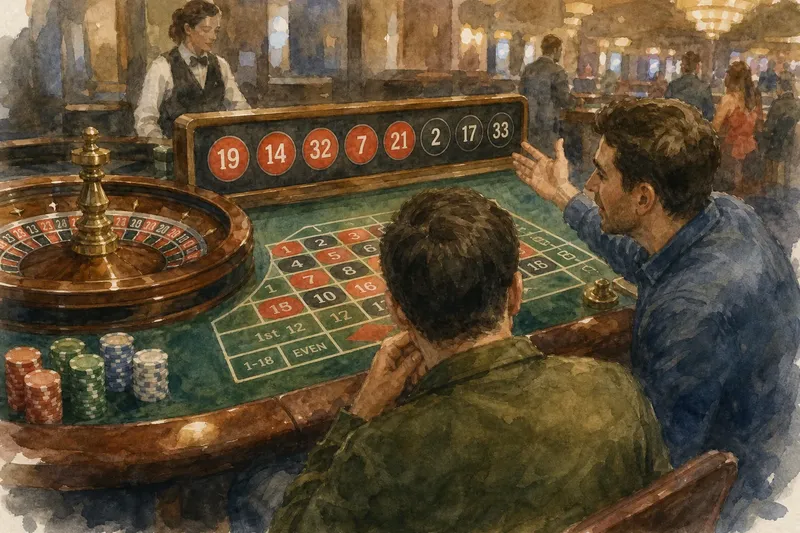
A roulette display shows a string of red results, and a player says, “Red is hot.” That phrase has already done two jobs: it describes a visible run and hints at a story about what it means. Understanding hot and cold language starts with separating those jobs.
Hot and cold language
In casino conversation, “hot” can describe a player who has recently won, a table producing notable results, or a sequence with a shared feature. “Cold” can refer to a losing stretch, a quiet table, or an outcome that has not appeared in the stretch someone is watching. The words summarize a particular point of view; they are not precise game terms unless a game’s rules define them that way.
Ask what the speaker means and what results they have in mind. “That player has won several recent hands” reports a record. “That player is hot” compresses the record into a vivid label. The label may be convenient, but it leaves the boundaries and meaning of the run unstated.
There is also a difference between describing the past and forecasting the future. “Red has appeared repeatedly in this display” is an observation. “Red will appear next” is a prediction. The observation alone does not supply a reason for the prediction.
Set the streak’s boundaries
A streak needs a defined subject and scope. Is the speaker counting one player’s wins, roulette colors, or a feature in a card game? Which results count, and where does the run begin? Without those details, two people can use “hot” for different records.
Displays and conversation can make the boundary seem obvious when it is actually selective. A striking run attracts attention; less memorable outcomes around it may not make it into the story. Prefer a plain description that names the record, such as “the recent display shows several red results,” over a broad claim that a color is taking over.
Say you see a roulette display with red listed four times in a row, and a friend calls red “hot.” You note that the claim refers only to those four entries, then describe the display as a run of red results rather than as a forecast. The resulting answer is clear: the label refers to a past sequence, while the next result remains undecided by that description.
Read the game’s language
Casino talk appears in player conversations, commentary, signs, and game displays. The same word can be casual shorthand in one setting and part of a named feature in another. Check the rules before assuming that a promotional or conversational phrase changes how a game works.
Use these checks to identify what a hot-or-cold claim is doing:
- Recent record: If the speaker names outcomes that have already occurred, then treat “hot” or “cold” as a recap; if no outcomes or time span are given, then ask which results the label covers.
- Player experience: If the word refers to a player’s wins or losses, then describe that run as personal experience; if it is used to predict the player’s next result, then ask what supports the forecast beyond the run.
- Game feature: If the game rules name a feature that changes play, then check its written explanation; if “hot” is only a nickname or display label, then do not treat it as a rule.
- Prediction: If someone says a streak points to a future outcome, then ask for a basis separate from the streak; if none is offered, then keep the claim in the category of speculation.
- Entertainment or promotion: If a sign or commentary uses dramatic language, then read it as presentation unless the rules say otherwise; if it makes a concrete claim about play, then check the rules that govern that claim.
- Personal decision: If “hot” or “cold” is being used to justify a larger wager or chasing a loss, then pause and return to a limit set beforehand; if play feels difficult to control, then step away and seek support from a qualified local service.
Questions about streak language?
Does “hot” predict a win?
No. In ordinary conversation, “hot” usually summarizes past results or a player’s recent experience, not a future outcome. A prediction needs a basis beyond the label itself.
What does “cold” mean at a table?
It commonly describes a run someone sees as quiet or unfavorable, but the exact meaning depends on the speaker and game. Ask which results they are counting before treating the word as a precise description.
Can a casino game have a hot feature?
A game may use a named feature or special rule, but that is different from informal talk about a streak. Read the game’s own rules to learn what the feature means and whether it changes play.
Why do streaks get memorable names?
A repeated pattern is easy to spot and retell, while a mixed stretch can be harder to summarize. Once a name catches on, it can also obscure which results were included and where the speaker drew the boundary.
Describe the record plainly
When discussing a run, name what happened without attaching an unsupported forecast. “The display lists several red results” gives the listener a record to consider. “Red is hot, so it will hit next” turns that record into a claim the wording does not establish.
Think of the label as a tag on a file folder: it can identify what someone has grouped together, but it does not change the contents. This is useful in conversation, commentary, and personal notes because it keeps the observed sequence separate from interpretation.
If you are deciding whether to continue playing, do not use a hot-or-cold label as a reason to increase a wager or chase a loss. Set limits that fit your circumstances, and step away if play stops feeling manageable. For help with gambling concerns, contact a qualified support service in your area.
The next time you hear a game called hot or cold, ask which past results the phrase covers. That question makes the conversation more precise—and keeps a memorable label from being mistaken for a forecast.